What Is a Double DIN Head Unit?
A double DIN head unit fills a standardized 180 x 100 mm dash opening — what that means, where the size came from, and how to check your car.
We earn a commission if you buy through links on this page. How this site makes money.
The short answer
A double DIN head unit is a car stereo built to fill a standardized dash opening 180 mm wide and about 100 mm tall — roughly 7 inches by 4 inches. It’s twice the height of the older “single DIN” size (180 x 50 mm, about 7 x 2 inches), which is where the name comes from. If your factory radio is a big rectangle rather than a small slot, there’s a good chance your car already has this opening, and that’s the whole reason the double-DIN aftermarket exists: swap the factory unit for one built to the same size, and it drops into the same hole.
Where the size actually comes from
DIN stands for Deutsches Institut für Normung, the German national standards body. In November 1979 it published DIN 75490, which set the dimensions for a car radio chassis at 180 mm wide by 50 mm tall — what everyone now calls single DIN. The rest of the world picked this up a few years later: the International Organization for Standardization adopted it as ISO 7736 on 1 March 1984, and that international version is what let manufacturers all over the world build radios and dash openings to the same size without coordinating with each other directly.
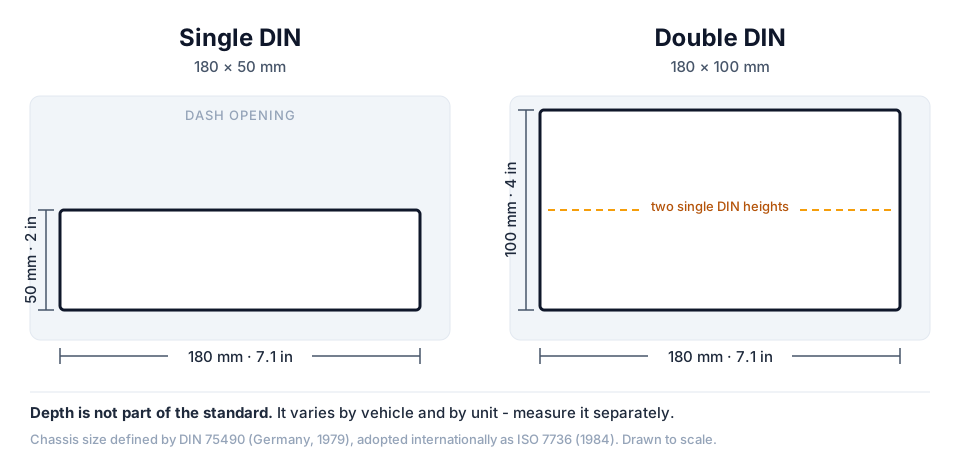
“Double DIN” isn’t a separate DIN- or ISO-numbered standard of its own. It’s the industry’s shorthand for an opening at the same 180 mm width but twice the height — commonly cited as 100 mm, sometimes 100.3 mm depending on the source, so treat that last fraction of a millimeter as noise rather than a meaningful difference. What the standard actually locks down is width and height, and the general concept of a mounting rail so that a chassis from one manufacturer physically interchanges with an opening built by another. It does not fix how deep the opening is — that’s set by each vehicle and each head unit, and it’s handled separately with dash kits and mounting sleeves rather than by the DIN spec itself. That’s also why “will it fit” is never fully answered by width and height alone; depth is worth checking on its own, which is covered in how to measure your dash opening.
Why a 1979 spec still matters in 2026
The honest answer is inertia, and it’s a good kind. Because the chassis size was locked down decades ago, a radio built today still fits an opening designed for a radio built in 1985 — and, more usefully, it fits into millions of vehicles built across the intervening decades by dozens of manufacturers. That’s the entire value proposition of the aftermarket double-DIN market: buy almost any brand, from a budget Android unit to a flagship Sony, and it’s built to the same 180 x 100 mm size as the factory unit it’s replacing, with a dash kit doing the cosmetic work of matching your specific trim.
That inertia is also why even current touchscreen units, with Apple CarPlay and Android Auto built in, are still sized to the same legacy opening. It’s not because the size is technically optimal for a modern screen — it’s because staying at 180 x 100 mm keeps a new unit compatible with decades of vehicles and with the entire existing ecosystem of dash kits and brackets from companies like Metra and Scosche. Change the size and you’d strand both the installed base of cars and the industry that supports them.
Where the standard is starting to break down
Not every modern dashboard actually has this opening anymore, and that matters more than the history lesson. A number of newer vehicles were designed from the start around one large integrated touchscreen rather than a removable double-DIN box, and behind that screen there’s often no true double-DIN cavity at all — just a shallow mount sized for one specific factory-shaped part.
The clearest examples are recent trucks and sedans. The redesigned 2019-and-later Chevrolet Silverado and GMC Sierra 1500 have no generic double-DIN dash kit; the practical aftermarket path is an OEM-shaped replacement screen, not a standard double-DIN unit. The same is true of the 2021-and-later Ford F-150 with its 8- or 12-inch Sync 4 display, and of the 2021-and-later Toyota Camry, where even Metra’s own kit for that generation is built around one specific 9-inch modular receiver rather than a generic opening. The Jeep Wrangler JL (2018 and later) has a genuine double-DIN-width opening but such limited mounting depth behind it that a normal-depth double-DIN chassis physically won’t go in — the realistic options there are shallow-mount, single-DIN-depth chassis paired with a separate floating screen, not a conventional double-DIN box. On all of these, don’t assume a double-DIN swap is even on the table until you’ve checked your specific vehicle; buying a universal unit and hoping a kit will make it work is how people end up with a radio that’s mechanically wedged into a gap it was never built for.
How to tell what your car has
Start by looking, not guessing. Pop the factory unit’s trim panel or peer around its edges: if you’re looking at roughly a 7-by-4-inch rectangle, that’s the shape of a double-DIN opening, even if the factory unit itself doesn’t look like an aftermarket radio. If it’s a much shorter slot — roughly 7 by 2 inches — you have a single-DIN opening, which is a different (and also common) situation covered in single DIN vs double DIN.
Looks can mislead you, though, especially on newer vehicles with large integrated screens. Two cars can look similar from the driver’s seat and have completely different realities behind the dash — one a genuine double-DIN cavity, the other a shallow proprietary mount with no room for a standard chassis. The reliable way to know is to check your specific year, make, model and trim rather than judge by the screen size. Our fitment pages do exactly that: look up your Toyota Tacoma, your Honda Civic, your Chevrolet Silverado, your Ford F-150, or your Toyota Camry and see whether it’s listed as a true double-DIN opening or one that needs a shape-matched, custom-fit part instead.
Once you know your car actually has the opening, the next steps are measuring it properly, so you don’t buy the wrong depth, and picking a dash kit that matches your trim. How to measure your dash opening covers the first; dash kits explained covers the second.
Frequently asked questions
Is double DIN the same as 2 DIN?
Yes. "Double DIN" and "2-DIN" are the same thing — a car stereo opening 180 mm wide and roughly 100 mm tall, twice the height of a single-DIN slot.
Is double DIN an official ISO standard?
The width and height come from DIN 75490 (Germany, 1979) and its international adoption as ISO 7736 (1984), but those standards define single DIN. Double DIN is industry shorthand for an opening twice that height at the same width, not a separately numbered standard.
Does every car with a touchscreen have a double-DIN opening?
No. A number of newer vehicles build their factory touchscreen into a shallow, proprietary opening with no true double-DIN cavity behind it. You have to check your specific vehicle rather than assume from the presence of a touchscreen.
How deep is a double-DIN opening?
The DIN/ISO standard doesn't fix a depth — only width and height. Depth varies by vehicle and by head unit, which is why dash kits and a depth check matter as much as the width and height numbers.
My car has one slot, not two stacked half-slots. Is that still double DIN?
Yes. Double DIN describes one opening 100 mm tall, not two separate single-DIN slots stacked on top of each other. If your factory radio fills a roughly 7-by-4-inch rectangle, that's what people mean by double DIN.
Check what fits your car
Every unit above still has to physically fit your dash. These pages list what actually bolts into these vehicles, plus the dash kit, harness and adapters each swap needs: