Dash Kits Explained
What a dash kit physically does, why it has to match your exact vehicle, and why the finished look depends more on the kit than the radio.
We earn a commission if you buy through links on this page. How this site makes money.
What a dash kit actually does
A dash kit is a vehicle-specific accessory that adapts a universal single- or double-DIN head unit to fit one particular car’s dashboard — a specific year, make, model and often trim. It doesn’t do anything to the radio itself. It exists entirely to solve the gap between a standardized chassis size and a dashboard opening that was designed by your car’s manufacturer, not by the aftermarket industry. Without the right kit, a double-DIN radio might not physically align with your mounting points, and even if it does, the finished install will look like a box wedged into a hole instead of something that belongs there.
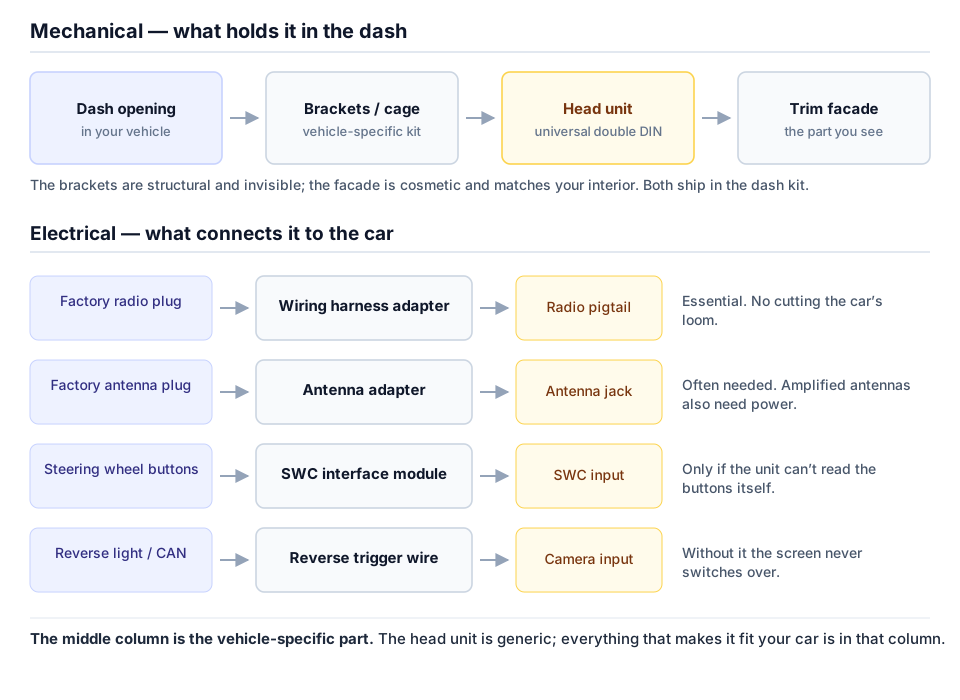
Every kit is really two different parts doing two different jobs, and understanding the split explains almost everything else about how they work.
Brackets: the part nobody sees
The bracket, sometimes called a cage, is the structural piece. It’s metal or plastic hardware that holds the head unit square, level and at the correct depth inside the dash opening. Depending on the vehicle, brackets snap onto the back of the trim plate, bolt directly to the car’s factory mounting points, or reuse your original radio’s own mounting hardware — the carriage bolts and kep nuts that held the factory unit in place before you touched anything.
The bracket’s entire job is mechanical. It doesn’t affect how the finished install looks, and once the facade is on, you’ll never see it again. But get the bracket wrong — the wrong depth, a poor fit to the factory mounting points — and the radio sits crooked, rattles, or won’t seat far enough back for the facade to close flush against the dash.
Facade: the part everyone sees
The facade, also called the trim plate or bezel, is the cosmetic overlay that snaps or bolts on after the head unit is mounted. It’s molded and colored to match your specific vehicle’s interior plastic, so there’s no visible gap and no mismatched texture around the new radio. This is the piece that determines whether an install looks factory or looks installed.
A few related parts show up in kits depending on the vehicle: radio pockets are support sleeves for single-DIN units that cradle the radio on every side but the front, radio housings support a double-DIN unit on every side but the top (leaving room for ventilation and wiring), and delete plates are blank cosmetic panels used when no radio pocket is included at all. Which combination your car needs depends entirely on how its factory radio bay was built.
Installation order generally follows the same logic across vehicles: mount the bracket or cage to the head unit and the car’s factory mounting points first, secure that assembly into the dash opening, and only then snap or bolt the facade on last to finish the cosmetic appearance.
Why the kit is vehicle-specific in the first place
Factory dash openings, mounting-point locations, trim colors and textures, and the layout of surrounding controls — climate switches, storage pockets, cupholders — differ by make, model, year and often trim level, even when the head unit going in is a completely generic DIN-size chassis. A kit built for a 2016 Toyota Tacoma has no reason to fit a 2019 Honda Civic, and a kit built for a Civic EX won’t necessarily fit a base LX, because the factory openings behind those dashboards aren’t the same shape.
Metra’s kit catalog makes the point concretely. The Toyota Tacoma (2016–2023) uses Metra 99-8251B, which comes with multiple trim plates to cover different Tacoma trims across that generation. The Chevrolet Silverado 1500 (2014–2018) uses Metra 99-3014G, built around that truck’s swappable radio-bay pocket. The Ford F-150 (2015–2022) uses Metra 99-5834CH — but only on trucks with the small 4.2-inch base display, not the 8-inch Sync 3 screen, because those two F-150 dashboards aren’t built the same way even though they’re the same model. The Honda Civic (2016–2021) splits by trim entirely: Metra 99-7821B for EX and above, and a completely different single-DIN-only kit, 99-7812B, for base LX trims. On the Toyota Camry, Metra 99-8266BLHG covers select 2018–2020 cars with a separate climate bezel, while the 2021-and-later redesign uses 109-TO8HG — built specifically around a 9-inch Pioneer modular receiver, not a generic double-DIN opening at all.
That last example is worth sitting with: on some newer vehicles, no dash kit exists that turns the factory opening into a true double-DIN slot, because the factory opening was never built around one. In those cases, buying any dash kit at all won’t help — the honest fix is a shape-matched replacement, or keeping the factory unit. Check your specific vehicle before assuming a kit exists.
The look depends on the kit more than the radio
This is the part people underestimate. A $150 head unit installed with a well-fitted, correctly color-matched kit can look completely factory-installed. A $600 head unit installed with the wrong kit, a cheap universal trim ring, or no kit at all can look like exactly what it is — an aftermarket box bolted into a hole that wasn’t built for it. The radio behind the facade barely affects how the finished dash reads to anyone glancing at it. The facade does almost all of that work, which is why it’s worth getting the kit right even if you’re being frugal on the head unit itself.
What a kit costs
Dash kits are inexpensive relative to everything else in the job — cheap enough that skimping on the kit to save money rarely makes sense once you’ve already committed to a head unit that costs several times as much. Exact pricing moves around by retailer and by how complex your specific vehicle’s kit is (a multi-trim-plate kit like the Tacoma’s 99-8251B costs more to tool than a simple single-plate kit), so check current pricing for your exact part number before you buy rather than assuming a number here.
What to check before you buy
Confirm your kit’s part number is listed for your exact year, make, model and trim — not just the model name. Some kits (like the Civic split between 99-7821B and 99-7812B) look interchangeable at a glance but aren’t. Once you’ve confirmed the kit, wiring harness basics and antenna adapters cover the two other pieces you’ll need before the radio goes in, and if your steering wheel controls or reverse camera run over a digital signal rather than plain wiring, steering wheel control interfaces and CAN-bus adapters explain what changes. If your vehicle turns out to have a shallow factory cavity behind the dash rather than a true double-DIN depth, mounting depth explains why that changes which radios are even an option. For the full install sequence once your kit and harness are both in hand, see how to install a double-DIN head unit.
Frequently asked questions
Do I still need a dash kit if my head unit is already double-DIN sized?
Yes. The head unit's chassis being double-DIN size only means it will physically fit the standardized opening. Nothing about that size guarantees it will bolt to your car's mounting points or that there won't be a gap around the faceplate — that's the kit's job, not the radio's.
Can I use a cheap universal trim ring instead of a vehicle-specific kit?
You can, but it usually looks like it. A universal ring isn't molded to your dash's exact contour or color, so you tend to get a visible seam or a mismatched plastic texture. A kit built for your year, make and model is what actually disappears into the dash.
What's the real difference between the bracket and the facade?
The bracket (or cage) is structural — it holds the radio square, level and at the right depth, and nobody but you ever sees it. The facade is the cosmetic trim plate that snaps on last and is the only part of the kit anyone actually looks at.
Will a dash kit work with any brand of head unit?
Generally yes, because a dash kit is built around the standardized double-DIN (or single-DIN) chassis opening, not around a specific brand. A kit for your Tacoma will accept a Pioneer, a Kenwood, a Sony or one of the Android-platform units, as long as the chassis is the size the kit was designed for.
Check what fits your car
Every unit above still has to physically fit your dash. These pages list what actually bolts into these vehicles, plus the dash kit, harness and adapters each swap needs: